_edited.png)
.png)
%20(3000%20x%201000%20px)%20(100%20x%2050%20px)%20(1).jpg)
The Real Reason Some People Avoid Accountability

Updated: 5 days ago

One thing I have learned in life is that not everybody knows how to handle honesty.
You can come to someone calmly.
You can choose your words carefully.
You can try your best not to sound angry, harsh, or disrespectful.
You can explain what hurt you in the softest way possible.
And somehow, the conversation still turns into something else.
Now it’s not about what they did.
Now it’s about your tone.
Now it’s about how you said it.
Now it’s about why you brought it up.
Now it’s about how long ago it happened.
Now it’s about how they think you are always making things a big deal.
And before you know it, you are sitting there wondering how a conversation about your hurt turned into you defending your character.
I think many of us as women know that feeling too well.
We already spend so much time trying to communicate in a way that makes other people comfortable.
We think before we speak.
We soften our words.
We try not to sound too emotional.
We try not to sound too strong.
We try not to sound like we are attacking anybody.
We explain ourselves over and over, hoping that if we say it the right way, maybe this time they will finally understand.
But I have learned something the hard way.
Some people are not confused by what you said.
They are uncomfortable with what your words are asking them to face.
That is a very different thing.
Sometimes people avoid accountability because the truth brings up feelings they don’t want to sit with.
Guilt.
Shame.
Embarrassment.
Pride.
Fear of being wrong.
Fear of looking bad.
Fear of having to admit they hurt someone they claim to care about.
Instead of facing those feelings, they turn the conversation around.
They focus on your delivery.
They bring up something you did months ago.
They accuse you of being dramatic.
They say you are too sensitive.
They tell you that you took it the wrong way.
They act like your reaction is the real problem instead of what caused your reaction in the first place.
That is what makes it so exhausting.
Because now you are not just trying to explain your hurt.
You are also trying to prove that you have a right to feel hurt.
And that right there can make a woman start questioning herself.

I know what it feels like to replay a conversation in my mind and wonder if I said too much.
I know what it feels like to ask myself if I should have waited, softened it more, used different words, or stayed quiet altogether.
But the older I get, the more I realize that someone’s defensiveness doesn’t automatically mean I did something wrong.
Sometimes it means the truth got too close.
That doesn’t mean we shouldn’t care about how we communicate.
We should.
Respect matters.
Kindness matters.
Timing matters.
Self-control matters.
I believe in speaking with wisdom, not just emotion.
But I also believe this.
You shouldn’t have to shrink your truth down to nothing just so someone else doesn’t have to feel uncomfortable.
If that is the case, then why even bring it up?
There is a difference between being respectful and being silent.
There is a difference between being kind and letting people keep hurting you.
There is a difference between choosing your words wisely and carrying the blame for someone else’s refusal to listen.
Accountability is not just saying, “I’m sorry.”
Real accountability sounds like, “I hear you.”
It sounds like, “I didn’t realize I made you feel that way.”
It sounds like, “I need to think about that.”
It sounds like, “I may not have meant to hurt you, but I can see that I did.”
It sounds like, “Let me take responsibility for my part.”
That kind of response takes maturity.
And not everybody has that.
Some people only want peace if peace means you never bring up what hurt you.
They want things to feel normal again, but they don’t want to talk about what broke the trust.
They want access to you, but they don’t want responsibility for how they treated you.
And that is where many women get stuck.
Because we start believing that if we explain it better, they will finally get it.
If we are calmer, they will listen.
If we cry less, they will take us seriously.
If we give more examples, they will understand.
If we make ourselves easier to hear, they will finally care.
But sometimes the issue is not that you explained it wrong.
Sometimes the issue is that they don’t want to be accountable.
And you can’t force that.

You can’t make somebody become honest with themselves just because you are being honest with them.
You can’t make someone reflect just because you handed them the truth gently.
You can’t make a person grow when they are more committed to protecting their ego than protecting the relationship.
That truth can hurt.
Especially when it is someone close to you.
A family member.
A friend.
A partner.
A coworker.
Someone you thought would care more.
Someone you thought would understand.
Someone you gave chance after chance because you kept hoping the next conversation would finally be different.
But at some point, we have to ask ourselves a hard question.
How many times am I going to explain my pain to someone who keeps acting like my pain is an inconvenience?
That question can change everything.
Because once you see the pattern, you can’t unsee it.
You start noticing who listens and who performs.
You start noticing who apologizes and who makes excuses.
You start noticing who wants understanding and who wants control.
You start noticing who is willing to grow and who only wants you to let it go.
And let me say this clearly.
Letting something go is not the same as pretending it didn’t happen.
Forgiveness does not mean you have to keep having the same conversation with someone who refuses to hear you.
Peace does not mean you have to keep opening the door to people who keep avoiding responsibility.
Sometimes peace means saying what you need to say once, maybe twice, and then watching what they do with it.
Because their response tells you a lot.
A person who cares may feel uncomfortable, but they will still try to understand.
A person who is growing may need time, but they will still be willing to reflect.
A person who values the relationship may not be perfect, but they won’t keep making your hurt all about them.
That is the difference.
We all make mistakes. I know I have.
None of us get it right every time.
We have all said things wrong, reacted from hurt, misunderstood someone, or needed grace.
But there is a big difference between making a mistake and refusing to take responsibility for it.
There is a big difference between being human and being unwilling to grow.
And as women, I think we have to stop carrying all the emotional weight in relationships where the other person refuses to carry their part.
We can be loving without being responsible for everybody’s self-awareness.
We can be patient without becoming someone’s emotional punching bag.
We can be understanding without making excuses for behavior that keeps hurting us.

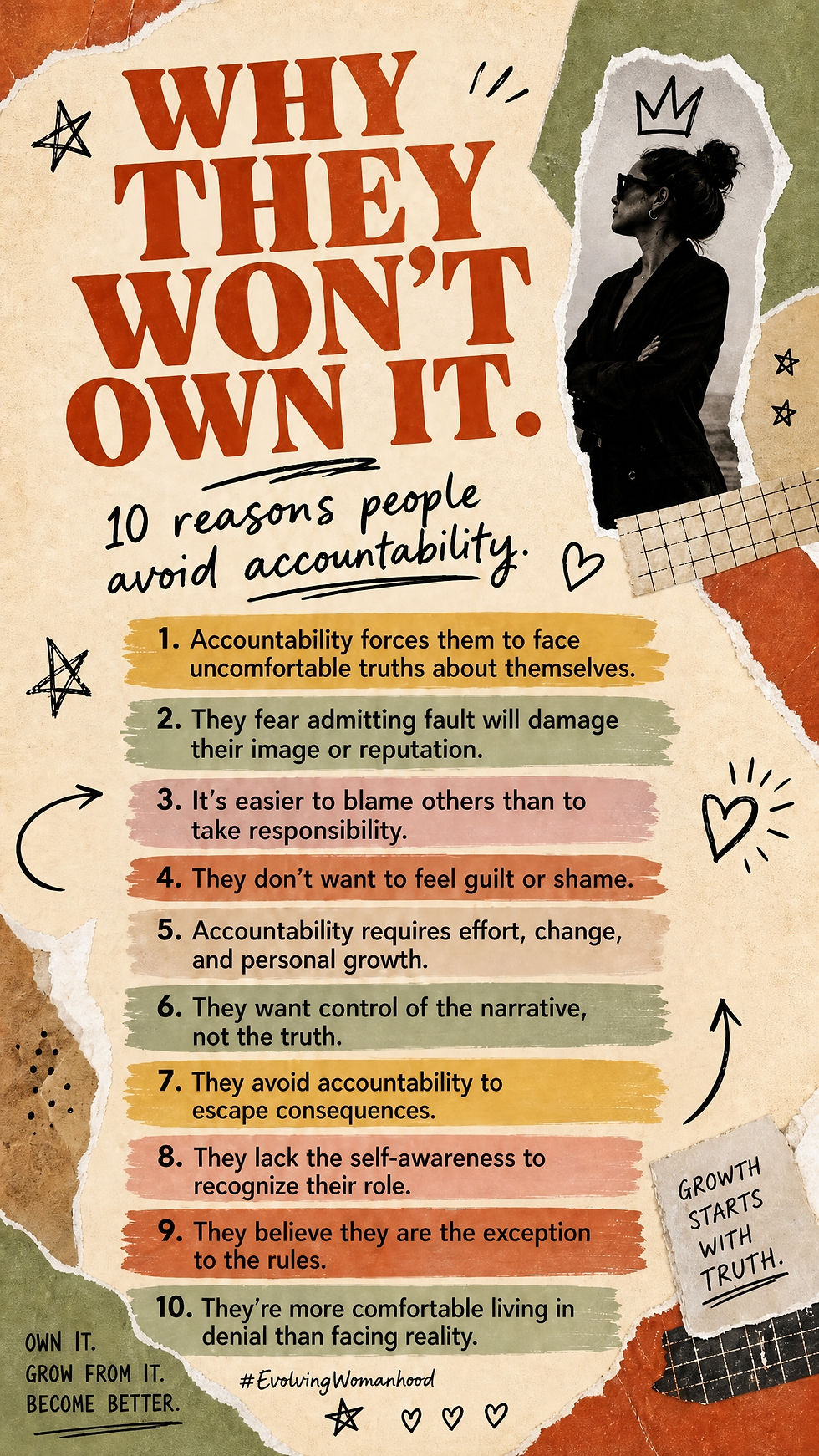
The real reason some people avoid accountability is because accountability requires them to look inward.
And looking inward can be uncomfortable.
It means facing what they did.
It means admitting they were wrong.
It means sitting with the fact that their actions affected someone else.
It means choosing growth over pride.
Some people are willing to do that.
Some people are not.
And as much as that hurts, it also gives us information.
It teaches us where to place our energy.
It teaches us who is safe to have honest conversations with.
It teaches us who values the truth and who only values comfort.
I have learned that I can speak honestly, but I can’t make someone receive it.
I can explain my feelings, but I can’t force someone to care.
I can invite someone into a healthier conversation, but I can’t drag them into maturity.
And I don’t have to keep blaming myself when someone refuses to take responsibility.
Because my voice still matters.
My feelings still matter.
My experience still matters.
And so does yours.
If someone keeps avoiding accountability, that doesn’t mean you failed to explain yourself.
It may mean they are not ready or willing to face the truth.
And sometimes the most loving thing you can do for yourself is stop begging someone to understand what they keep choosing to dismiss.
Speak your truth with grace.
Pay attention to their response.
Protect your peace.
And don’t keep carrying blame that was never yours to begin with.
Healing Workbooks: Visit for Support



Comments