_edited.png)
.png)
%20(3000%20x%201000%20px)%20(100%20x%2050%20px)%20(1).jpg)
Have You Forgotten What It Feels Like to Be Touched?

Updated: 5 days ago

I saw a picture of myself hugging one of my children last year.
At first, I didn’t think much about it.
It was just a picture.
One of those ordinary moments we capture without realizing it may later show us something we weren’t ready to see.
Then it hit me.
That may have been the last time I touched another human being.
Not the last time I had sex.
Not the last time someone held me romantically.
The last time my skin actually touched another person’s skin.
The last time I felt someone’s arms around me.
The last time my body experienced the warmth and weight of another human being close to mine.
I sat with that realization longer than I expected to.
And honestly, it made me sad.
I have no one in my everyday life who reaches for me.
No one who hugs me when they walk through the door.
No one whose hand finds mine while we’re sitting together.
No one who leans against me on the couch or stands close enough for our shoulders to touch.
I don’t say that for pity.
I say it because there may be another woman reading this who has quietly realized the same thing.
Maybe it has been months.
Maybe it has been years.
Maybe you can’t remember the last time someone held you without wanting something from you.
When your body hasn’t been touched for a long time, I think it begins to forget.
Not completely. Our bodies are too wise for that.
But we forget what it feels like to relax inside someone’s arms.
We forget how it feels to be close without becoming watchful.
We forget how to receive tenderness without wondering what it will cost us later.
Eventually, we may even convince ourselves that we no longer want it.

That part makes sense to me.
Wanting something you haven’t had in a long time can hurt.
Sometimes it feels easier to stop naming the need than to keep feeling the empty space where it should be.
So the body adapts.
It builds a protective layer around the longing.
It learns not to reach.
It learns not to expect.
It learns how to sleep alone, wake up alone, calm itself alone, and carry difficult days without anyone putting a hand on its back and saying, without words, “I’m here.”
After a while, touch may even begin to feel unfamiliar.
Someone steps too close and your body stiffens.
Someone reaches toward you and you wonder what they want.
A hug lasts a little longer than expected and instead of melting into it, part of you stays alert.
That doesn’t necessarily mean you hate affection.
It may mean you’ve been without safe affection for so long that your body no longer knows what to do with it.
The need didn’t disappear.
It may have just gone quiet.

The loneliness we don’t always have words for
We talk about emotional loneliness.
We talk about not having anyone to call.
We talk about missing companionship, romance, friendship, and family.
We don’t talk as often about what it means to go without touch.
There’s a term sometimes used for this experience: touch deprivation, also called skin hunger.
It describes the longing that can grow when we go without wanted physical contact.
During periods of social distancing, a study of 1,746 adults found that lacking intimate touch was connected with greater loneliness and anxiety.
People differed in how strongly they craved touch, which matters because there isn’t one amount every woman is supposed to need.
That difference is important.
Some women naturally want more physical affection than others.
Some enjoy hugs but don’t need much touch during the day.
Others feel deeply cared for when someone holds their hand, rubs their back, or sits close beside them.
And for some women, touch is complicated.
Past experiences can teach a body that being touched isn’t always safe.
A woman may want closeness and fear it at the same time.
She may miss being held but tense when someone reaches for her.
She may need trust, consent, and time before her body believes that touch can be gentle again.
There’s nothing strange about that contradiction.
The body remembers what the mind tries to move past.
Wanted touch and unwanted touch are not the same experience.
Consent isn’t a small detail.
It changes the meaning of the moment entirely.
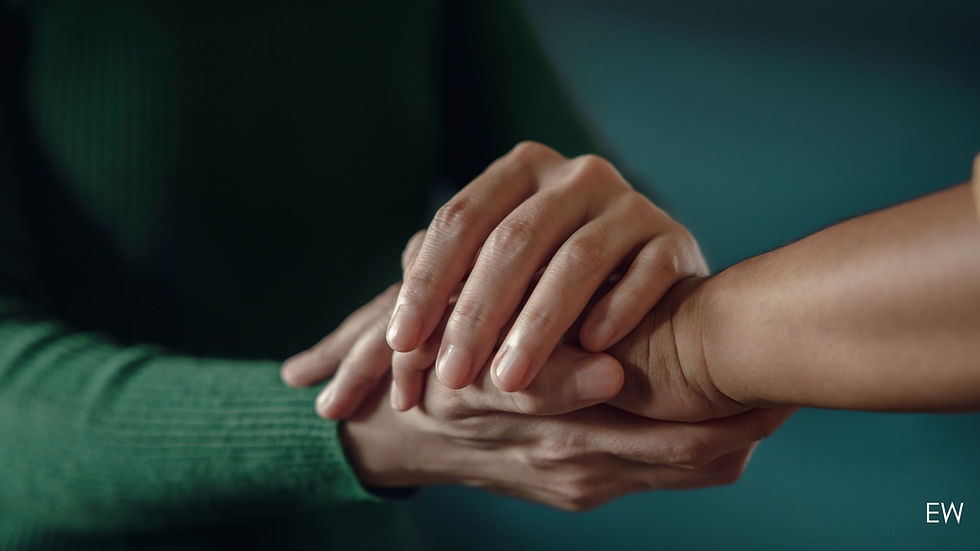
Touch isn’t only emotional
I used to think touch was mostly about affection.
It turns out our bodies respond to it too.
That doesn’t mean a hug cures depression or that affection replaces medical care, therapy, medication, friendship, or real support.
It means touch is not meaningless.
Our skin contains nerve fibers that respond especially well to slow, gentle stroking.
They appear to help carry the emotional side of touch, although our response to affection is more complex than one set of nerves or one hormone.
The science doesn’t support reducing it to a neat little formula where a certain kind of touch automatically creates a certain feeling every time.
Real bodies aren’t that predictable.
Still, it comforts me to know that the longing to be held isn’t neediness.
It isn’t weakness.
It isn’t proof that we haven’t learned to love ourselves enough.
We’re human.
We were never meant to experience every form of comfort alone.

Why my weighted blanket means so much to me
When I realized how long it had been since I’d been touched, I also understood something else.
Maybe that’s why I love my weighted blanket so much.
At night, when I pull it over myself, there’s pressure around my body.
It doesn’t replace a person.
A blanket can’t know me.
It can’t choose me.
It can’t look into my face and understand that I’ve had a difficult day.
But it gives my body the feeling of being covered, supported, and contained.
For a little while, I don’t feel quite so exposed.
That’s the unspoken truth about some of the things we use to comfort ourselves.
The long baths.
The pillows pulled tightly against our chests.
The pets we hold a little longer than necessary.
The heavy blankets tucked around our shoulders.
Sometimes our bodies are trying to give themselves a version of what they miss.
That isn’t pathetic.
It’s resourceful.

Can we give some of that safety to ourselves?
There’s a part of this conversation I don’t want to leave entirely in someone else’s hands.
Because some of us don’t have a safe person to hug right now.
Some of us aren’t in relationships.
Some of us live far from family.
Some of us have families who don’t feel emotionally safe.
Some of us are rebuilding after relationships where touch became cold, controlling, confusing, or absent.
We still deserve ways to feel at home in our bodies.
Self-soothing touch may offer a small place to begin.
That might look like placing a hand over your heart when you feel overwhelmed.
Resting your hands on your arms.
Rubbing lotion slowly into your skin instead of rushing through it.
Holding your own face gently.
Wrapping your arms around your body when the sadness rises.
I know that can sound awkward.
The first time we try to comfort ourselves in a new way, it may feel artificial.
We may feel silly.
We may wonder whether it counts when we’re the ones offering the comfort.
I think it counts differently.
A hug from someone we trust says, “You aren’t alone.”
Gentle touch from our own hands may say, “I’m not abandoning you while you are.”
Both matter.
And neither erases the honest desire to be held by another person.

Maybe you haven’t stopped wanting it
I’m still sitting with what that photograph showed me.
I wish I had a neat ending where I tell you I fixed this.
That I suddenly became more social, filled my life with affection, and never felt lonely again.
I didn’t.
My life is still my life.
There are still nights when my weighted blanket is the closest thing I have to being held.
There are still moments when I wonder whether my body would know how to relax in someone’s arms now, or whether it would stay guarded, waiting for the moment to change.
But I understand the ache a little better.
I’m not cold.
I’m not too independent.
I’m not broken because I’ve learned how to live without something I still need.
Maybe I adapted because I had to.
Maybe you did too.
So, I want to leave us with a question I haven’t fully answered for myself.
Have we truly stopped wanting to be touched or held?
Or have we been waiting so long that we stopped admitting it, even to ourselves?
Maybe the body hasn’t forgotten.
Maybe it has just been quiet, hoping that someday it will feel safe enough to soften again.
Healing Workbooks: Visit for Support


Comments