_edited.png)
.png)
%20(3000%20x%201000%20px)%20(100%20x%2050%20px)%20(1).jpg)
Healing After a Toxic Workplace and Reclaiming Your Confidence

Updated: 5 days ago

There is something about a toxic workplace that can make you question parts of yourself you used to be sure about.
And I know that feeling because I have worked under toxic bosses more than once.
Not just the kind of boss who has a bad day here and there.
I’m talking about the kind of environment where you start walking into work already tense.
The kind where your stomach drops when you see their name pop up.
The kind where you start replaying every conversation in your head, wondering if you said too much, not enough, said it wrong, sounded wrong, looked wrong, or somehow became the problem without even knowing how.
That kind of workplace can wear a woman down in quiet ways.
At first, you might try to be understanding.
You tell yourself maybe they’re stressed.
Maybe the company is going through something.
Maybe you just need to adjust.
Maybe if you work harder, stay quieter, explain yourself better, or prove yourself more, things will get easier.
But then it doesn’t get easier.
You start noticing the same patterns.
The dismissive comments.
The control.
The favoritism.
The moving goalpost.
The way your good work gets overlooked until someone else wants credit for it.
The way you can feel targeted, but when you try to explain it out loud, it sounds so small that you start wondering if you’re being too sensitive.
That is one of the hardest parts about being in a toxic workplace.
Sometimes the damage isn’t loud enough for everyone else to see, but it’s heavy enough for you to feel every day.
You go home tired, but not the regular kind of tired. It’s not just “I had a long day” tired.
It’s the kind of tired that follows you into your car, into your kitchen, into your sleep, into your mood, and into the way you see yourself.
You start second guessing yourself.
You start over explaining because you’re afraid of being misunderstood.
You start holding back in rooms where you were hired because you were qualified.
And somewhere along the way, you may even start wondering, “Is it me?”
That question right there can break your confidence if you sit with it too long.
Because when you’re around unhealthy leadership long enough, their behavior can start sounding like your inner voice.
Their criticism can start feeling like truth.
Their insecurity can start making you feel small.
Their lack of emotional maturity can make you question your own professionalism.
But I want to say this clearly.
A toxic boss does not get to define your worth.
A messy workplace does not get to decide who you are.
And someone else’s inability to lead with character does not mean you are hard to manage.
One thing I have learned is that a title does not always mean wisdom.
A position does not always mean maturity.
A person can have authority and still lack self-control, fairness, kindness, accountability, and emotional awareness.
That is a hard truth, but it’s an important one.
Because many of us were raised to respect authority.
We were taught to work hard, be polite, stay professional, and not cause problems.
And those things matter.

But what happens when the person in charge uses their position to belittle, control, intimidate, or silence people?
That is when we have to learn the difference between respect and fear.
Respect is healthy.
Fear slowly eats away at you.
And too many women have stayed in workplaces where we were expected to keep performing while our peace was being drained out of us.
I think one of the reasons toxic workplaces hit women so deeply is because many of us already carry so much.
We are used to being the responsible one, the calm one, the one who thinks things through, the one who tries to keep the peace, the one who doesn’t want to make a scene.
So even when something feels wrong, we try to manage it gracefully.
We try to be professional.
We try to keep our face together.
We try to not let it bother us.
But privately, it does bother us.
It bothers us when our work is questioned unfairly.
It bothers us when we’re talked down to.
It bothers us when we know we’re being treated differently, but we can’t always prove it.
It bothers us when we bring skill, effort, loyalty, and care to a place that keeps making us feel disposable.
And I don’t think we talk enough about how much confidence a toxic workplace can steal.
You can walk in as a woman who knows what she brings to the table, and after months or years in the wrong environment, you can start feeling unsure of everything.
You can start doubting your gifts.
You can start believing you’re not as capable as you once thought.
You can start carrying shame that was never yours to carry.
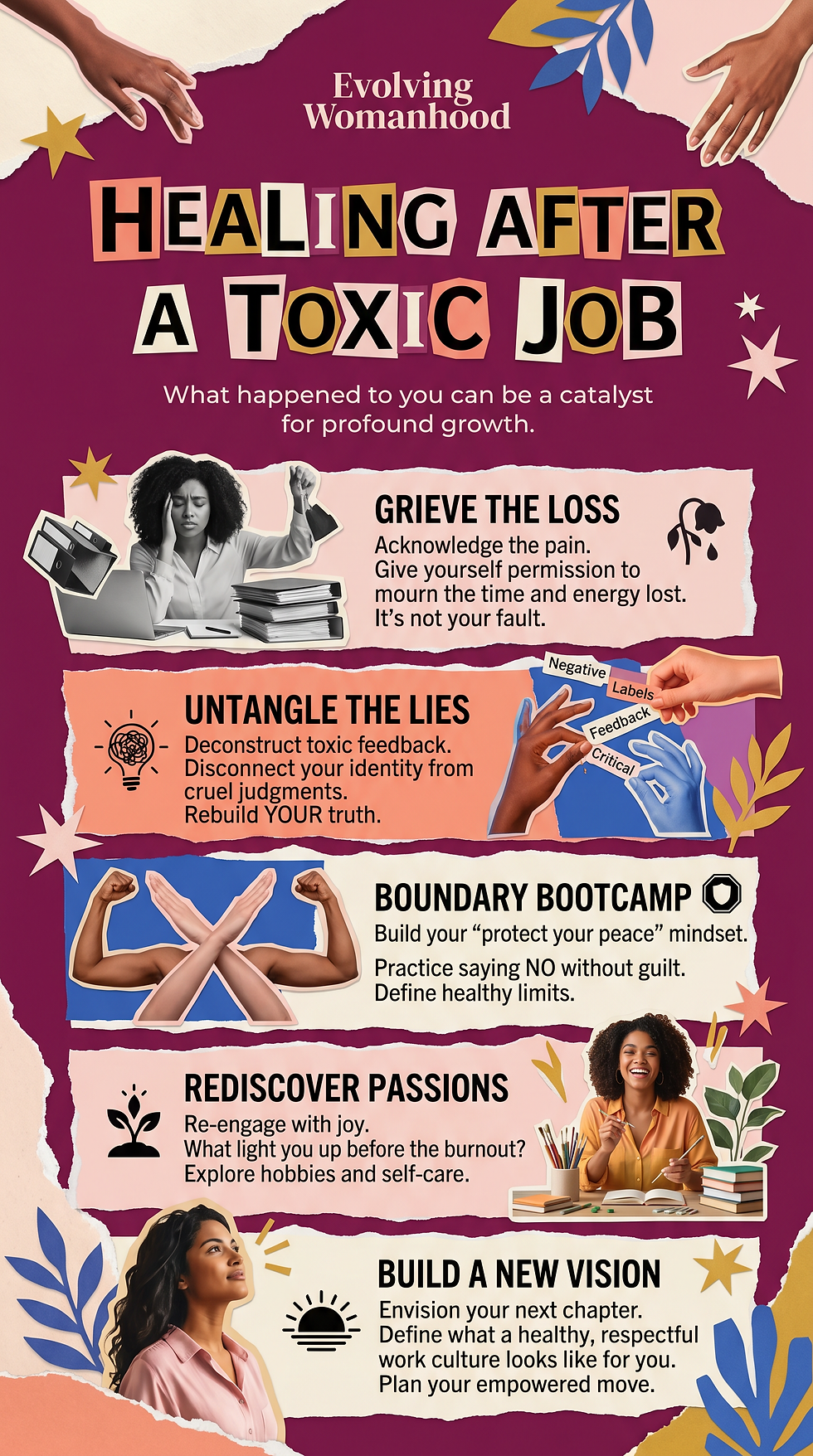
That is why healing after a toxic workplace is not just about getting another job.
It’s about getting yourself back.
It’s about separating what happened to you from who you are.
It’s about remembering that you had value before that job, during that job, and after that job.
And sometimes, the first step is admitting the truth to yourself.
“This environment hurt me.”
“This wasn’t normal.”
“I was doing my best in a place that was draining me.”
“I don’t have to keep calling disrespect a lesson.”
That kind of honesty matters.
Because when you have been in survival mode for too long, you can get used to being mistreated.
You can get used to bracing yourself.
You can get used to expecting people to misunderstand you.
You can get used to being anxious, guarded, and emotionally tired.
But that is not how you are supposed to live.
Work can be stressful, yes.
Every job has hard days.
Every boss has flaws.
Every workplace has issues.
But there is a difference between normal challenges and an environment that constantly makes you feel unsafe, unseen, confused, or small.
And when you recognize that difference, you start taking your power back.

For me, toxic workplaces taught me things I wish I didn’t have to learn the hard way.
They taught me that not everyone in leadership should be leading people.
They taught me that insecurity in a leader can turn into control over everyone else.
They taught me that some people are threatened by talent instead of grateful for it.
But they also taught me how to see things more clearly.
They taught me to pay attention to patterns.
They taught me to trust that quiet feeling inside when something feels off.
They taught me that peace is not something I should have to keep giving up just to prove I can handle pressure.
And they taught me that I don’t have to make myself smaller just to make someone else comfortable.
That lesson right there is one many women need to hold onto.
You don’t have to hide your strengths because someone else doesn’t know how to handle them.
You don’t have to over explain your value to people committed to misunderstanding you.
You don’t have to keep chasing approval from someone who keeps moving the line.
And you don’t have to let one workplace convince you that you are less than who you are.
If you are still in a toxic workplace right now, protect your mind as much as you can.
Write things down so you can stay clear about what is happening.
Talk to someone you trust so you’re not carrying it all by yourself.
Keep your responses professional, but don’t give everyone full access to your emotions.
Pay attention to how your body feels before, during, and after work.
Start thinking about what your next move could look like, even if you can’t leave right away.
And most of all, don’t internalize what belongs to someone else.
You are not weak because the environment affected you.
You are not dramatic because you noticed disrespect.
You are not difficult because you have standards.
You are not unqualified because someone else didn’t know how to lead you well.
Healing from a toxic workplace takes time because confidence doesn’t always come back all at once. Sometimes it comes back in small moments.
The first time you speak up again.
The first time you stop apologizing for something that wasn’t your fault.
The first time you realize you’re not nervous anymore.
The first time you walk into a healthier room and feel your shoulders finally drop.
That is when you begin to see how much you were carrying.
And that is also when you begin to realize that the workplace may have shaken you, but it didn’t destroy you.
You are still here.
You are still capable.
You are still learning.
You are still becoming.
Healing Workbooks: Visit for Support



Comments