_edited.png)
.png)
%20(3000%20x%201000%20px)%20(100%20x%2050%20px)%20(1).jpg)
I Spent Years Eating Last. Then I Learned Why Meal Timing Matters
- Maya Ellis

- 1 day ago
- 7 min read

For years, when I cooked for my family, I was usually the last person to eat.
I made the food.
I fixed plates.
I made sure everybody had what they wanted.
Somebody needed more of something.
Somebody didn't want what I made.
Somebody suddenly remembered they hated a food they had eaten perfectly fine the week before.
You know.
Family dinner.
By the time I sat down, everybody else had already started eating, finished eating, or disappeared from the kitchen altogether.
I never thought much about it.
That was just how I ate.
Now it's just me, and somewhere along the way I realized something kind of strange.
Nobody is waiting for me to cook for them anymore.
Nobody needs a plate fixed.
Nobody is standing in the kitchen asking me when dinner will be ready.
And yet I'm still eating late.
Apparently, everybody moved out of the kitchen except the habit.
As I've gotten older, I've started paying more attention to what I eat.
But lately I've been wondering about something I hadn't given nearly as much thought.
When am I eating?
Because if we're being completely truthful here, breakfast and I barely know each other.
Lunch isn't doing much better.
Sometimes I eat it.
Sometimes I look at the clock at three or four in the afternoon and realize lunch apparently left without me.
Then dinner comes around and suddenly my body would like to discuss every meal I've skipped since sunrise.
So, I started looking into whether the time we eat actually matters.
Turns out, it might matter more than I realized.

Breakfast and I May Need to Reintroduce Ourselves
I've never really been a breakfast person.
There.
I said it.
There are women who wake up thinking about eggs, oatmeal and toast.
I wake up thinking about everything I need to get done.
Food usually enters the conversation later.
For a long time, I didn't see anything wrong with that.
If I wasn't hungry, why eat?
I'm still not interested in forcing myself to eat because a clock says I should.
But learning more about our body's natural rhythm made me look at my habit differently.
Our bodies actually keep track of time.
Light in the morning helps set our main body clock, while the timing of food helps send signals to other parts of the body involved in things like digestion, blood sugar and metabolism.
A 2025 review found growing evidence that eating earlier in the day tends to line up better with the way our bodies naturally handle food.
That doesn't mean everybody needs breakfast at exactly 7:12 every morning.
Nobody needs another rule like that.
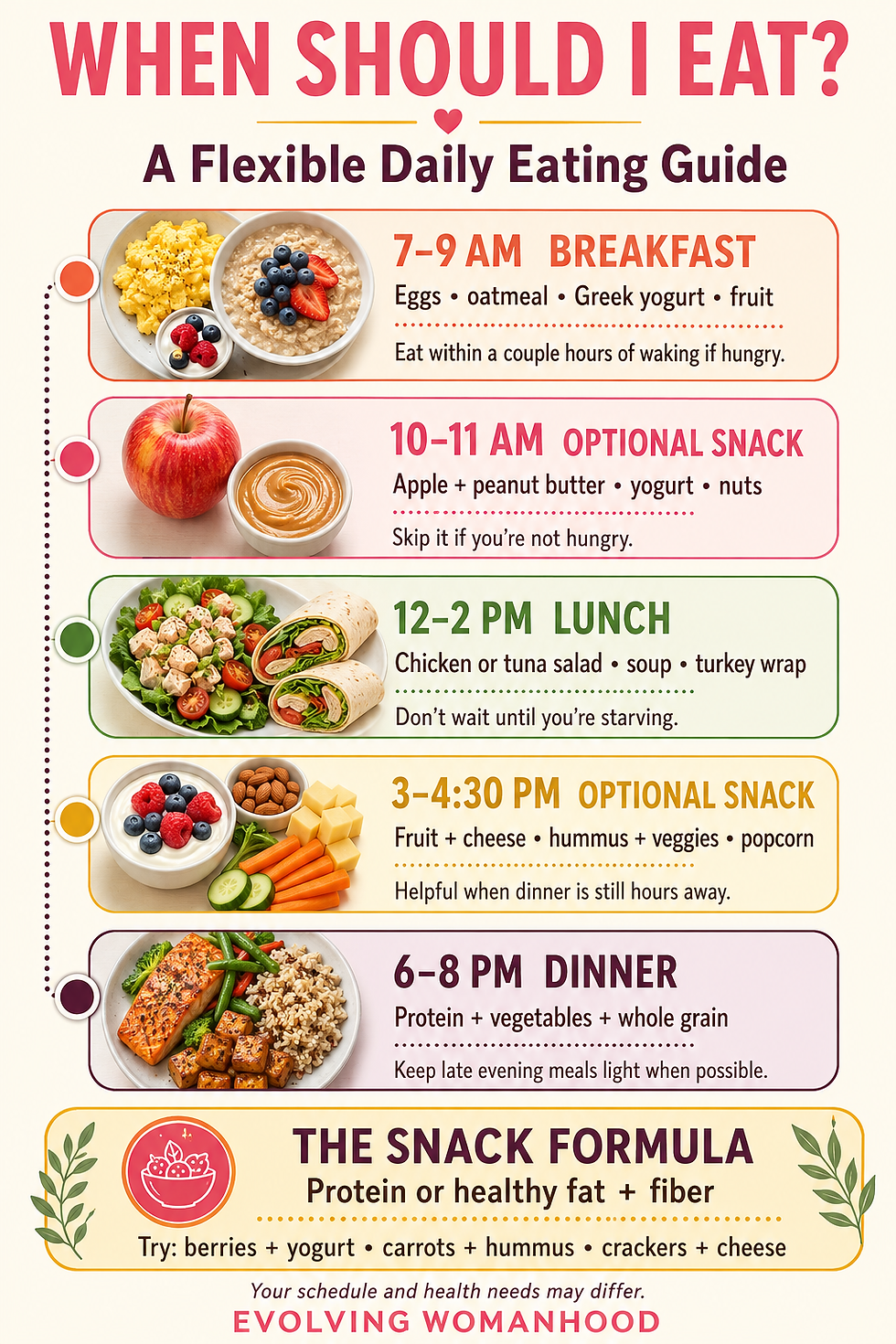
But breakfast somewhere around 7 to 8 in the morning may work well for someone who wakes early, while a later breakfast may make more sense for someone whose day starts later.
What caught my attention was a 2025 study that followed 2,945 older adults.
People who regularly ate breakfast later tended to have more health problems, and later breakfast was also linked with a higher risk of death over time.
The study doesn't prove that eating breakfast late caused those problems.
Health, sleep, lifestyle and other factors matter too.
Still, it made me think.
Maybe the question isn't, “Do I have to eat breakfast?”
Maybe mine is, “Why have I gotten so comfortable waiting half the day to feed myself?”
Those are two very different questions.

Somehow Lunch Keeps Falling Off My Schedule
Lunch is where things get ridiculous for me.
I can start doing something in the morning, get distracted by six other things, look up and somehow it's 2:37.
Then I'll think, I'll eat in a little while.
This is apparently a lie I tell myself regularly.
Because “in a little while” can turn into four o'clock surprisingly fast.
And that's usually when the hunger catches up.
You know that kind of hunger.
You're no longer thoughtfully deciding what sounds good.
You're opening cabinets like somebody hid money in there.
This is one reason I've started thinking differently about eating lunch somewhere around noon to 2 instead of letting the whole afternoon disappear.
Our bodies generally handle blood sugar better earlier in the day than they do later.
Reviews of meal timing studies have also found that eating more of our daily food earlier rather than saving most of it for later may help with weight, blood sugar and other parts of metabolic health.
Again, this isn't me saying lunch at 1:59 is healthy and lunch at 2:01 has ruined everything.
That's exactly the kind of health advice that makes people quit reading health advice.
The bigger pattern matters more.
And honestly, the bigger pattern is what got my attention.
I had become very comfortable treating eating like the least important appointment on my calendar.
Everything else could happen first.
Work.
Errands.
Phone calls.
Cleaning.
Whatever needed my attention.
Food could wait.
And I recognized something familiar in that.

The Family Grew Up, but I Was Still Eating Last
This part has less to do with nutrition.
For years, feeding other people came before feeding myself.
I wasn't standing in the kitchen thinking, “I'm putting myself last.”
I was just making dinner.
That's what makes some habits hard to see.
They don't always begin as some deep emotional problem.
Sometimes they're practical.
Somebody has to cook.
Somebody has to get the kids fed.
Somebody has to clean up.
Somebody has to make sure everybody has what they need.
Then life changes.
The children grow up.
The house gets quieter.
The responsibilities change.
But sometimes the routine stays sitting right where we left it.
I think that's part of what happened to me.
I got used to eating when everybody else was taken care of.
Now there's nobody else at my table waiting to be taken care of, and I still have days when I act like my own hunger can wait.
That realization bothered me a little.
Not because skipping lunch means I don't value myself.
I don't want to turn a sandwich into a personality test.
But because I started wondering how many little habits I'm still carrying from a life that doesn't exist anymore.
That thought stayed with me.

Apparently My Body Has Business Hours
The more I read, the funnier this became to me.
My body apparently has business hours.
I didn't know this.
I have been operating the place like a 24-hour diner.
But our organs don't work exactly the same way at every hour of the day.
Our body clock helps regulate digestion, hormones, blood sugar and other processes.
Eating very late can push food into a time when some of those systems are beginning to wind down for the night.
Which means my liver may have been trying to close and I was showing up with dinner.
Sorry, ma'am.
Kitchen's closing.
This doesn't mean eating late occasionally is dangerous.
Life happens.
We go out.
We work late.
The day gets away from us.
Sometimes dinner is at nine.
Sometimes dinner is standing over the sink eating leftovers because we didn't feel like dirtying another plate.
One late meal isn't the issue.
Patterns are what interest me.
A study of more than 103,000 adults, 79 percent of whom were women, every additional hour that the first meal was delayed was associated with about a 6 percent higher risk of cardiovascular disease.
Eating the last meal later was also linked with certain cardiovascular risks, and some of the associations were stronger in women.
That study found a connection, not proof that meal timing itself caused heart disease.
That's an important difference.
I don't want information that scares me into eating dinner at 6:03 every evening.
I want information that helps me notice my own habits.

Dinner Is Where My Old Routine Still Hangs Around
Dinner has probably been the biggest adjustment for me.
When you're feeding a family, dinner has a purpose beyond hunger.
It's part of the house.
People come home.
Food gets cooked.
Plates get made.
The kitchen gets loud.
Then one day life looks different.
Cooking for one is strange at first.
You can eat whenever you want.
You can have cereal for dinner.
You can eat leftovers directly out of the container and there's nobody there to report you.
Freedom.
But having no schedule can quietly become eating whenever I finally get around to it.
So, I've started looking at the 6 to 9 evening range differently.
Not as another health commandment.
More like a reminder that dinner doesn't have to wait until the entire day is over.
The evidence isn't perfect, and studies don't all agree on exactly which eating window is best.
Which, honestly, is good to know.
Because I don't want to trade one extreme for another.
I don't need to finish every meal by 2 PM because one study used that schedule.
I need something I can actually live with.

Maybe Healthy Eating Isn't Only About What's on My Plate
This may be the biggest thing I've taken from all of this.
I've spent years hearing about what we should eat.
Protein.
Vegetables.
Less sugar.
More fiber.
Drink water.
Read labels.
Watch portions.
By the time we're finished, grocery shopping feels like we're studying for an exam.
But I hadn't thought nearly as much about rhythm.
Not perfection.
Rhythm.
Eating at somewhat regular times.
Giving my body food before I'm so hungry I'll eat whatever happens to be closest.
Not saving most of what I eat for the end of the day.
Letting dinner happen early enough that I'm not going to bed while my stomach is still wondering what just happened.
There isn't one perfect schedule for every woman.
A woman working nights isn't going to eat on the same schedule as somebody working from home.
A mother getting children out the door at 7 AM has a different morning than a woman whose workday begins at ten.
Medication, health conditions, sleep, exercise, pregnancy and many other things can change what makes sense.
But I think there's room between obsessing over food and paying no attention at all.
That's the space I'm interested in.

I’m Not Changing Everything. I’m Just Paying Attention
I'm not suddenly becoming the woman who meal preps seven matching containers every Sunday.
If that happens, somebody should probably check on me.
I'm also not promising I'll wake up tomorrow craving breakfast.
But I am paying attention.
I'm noticing how long I go without eating.
I'm noticing when dinner keeps getting pushed later.
I'm noticing when I tell myself I'll eat after I finish one more thing.
That sounds so small.
Maybe it is.
But after years of being the woman who made sure everybody else had a plate before she sat down, there's something strangely meaningful about fixing my own food before I'm starving.
I don't think caring about when I eat needs to become another standard I have to meet perfectly.
I think it can be much quieter than that.
Breakfast when my day begins.
Lunch before the afternoon disappears.
Dinner before the night is nearly over.
Not because the clock is in charge of me.
Because I'm finally paying attention to the woman sitting at the table.
And these days, she's allowed to eat before everybody else is taken care of.
Even when the only everybody left in the room is me.


Comments